A surgeon's AI films: eight questions from Kerala
An interview with film critic P K Surendran, published in Malayalam by The Malabar Journal, September 2026. The English answers, as written.
Dr Samantha Pillay OAM
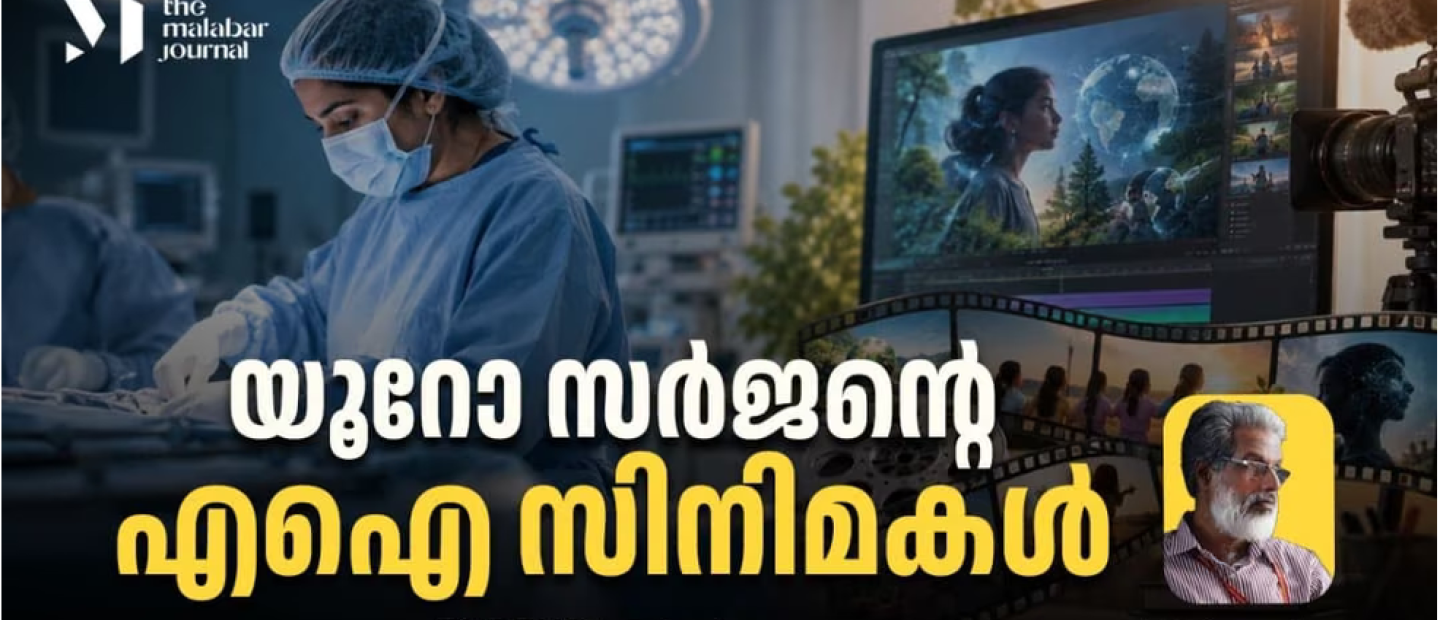
In September, a film critic from Kerala, India, wrote to me through this website. P K Surendran had read about a surgeon making films with AI and wanted to publish an interview in Malayalam, a language spoken by around 38 million people that I had to look up. His eight questions arrived with Bergson, Kant and Ritwik Ghatak attached, and they made me work out what I actually think about several things I had not written down before.
His questions and my answers are below, exactly as I sent them. The published interview, in Malayalam, is in The Malabar Journal.
1. Tell us your transition from a Urological Surgeon to filmmaking — especially using AI for film production? Have you ever attempted to make films using celluloid or digital formats before?
There was no transition. I am still a full-time surgeon. The films are made after hours, on weeknights and weekends, at my desk at home.
I had never made a film in any format. I had written children's picture books and used basic Canva for social media, and that was the extent of it. In June 2024 I wanted a short video for World Continence Week. I started with an AI image tool called Midjourney, which meant creating a Discord account. I was fifty-five and did not know what Discord was. Several tools and a few hours later I had an animated shape that vaguely resembled a bladder. By today's standards it was terrible. But I could see what it meant: video with no camera, no crew and no budget.
I enrolled in a four-week online AI filmmaking course that said no skills required. I do not think they realised I did not know what a timeline was. Later that year my first film, An Incontinent Truth, was nominated at an AI film festival in Dubai. So I did what any sensible surgeon with no film industry experience would do. I founded AIFilm4Good, the world's first AI film studio for social impact. The following year, An Incontinent Truth won Best AI Documentary in Paris.
2. (a) There are people supporting AI as well as people against AI. A major concern in philosophy of mind is that relying on AI risks reducing human experience, judgment and morality to pure computation, stripping actions of intrinsic moral value and human empathy. "The real danger is not that computers will begin to think like men, but that men will begin to think like computers" — Sydney J. Harris. (b) Philosophically, AI supports the Extended Mind Hypothesis, which argues that cognitive processes extend beyond the human skull into our tools. AI operates not as a replacement for the mind, but as an intellectual amplifier that expands human agency and problem-solving. "Our intelligence is what makes us human, and AI is an extension of that quality" — Yann LeCun.(c) Evan Hubinger has publicly expressed concerns that artificial intelligence could destroy humanity within the next decade. Hubinger is an AI Safety Lead at Anthropic, a premier AI research organization. His statement follows the recent resignation of his close colleague, Jacob Coxon, who stepped down over fears that control over AI might be lost.
What is your opinion?
I have not seen that researcher's statement and I do not repeat what I cannot verify. But the fear underneath it is real, so I will answer that.
AI will not destroy humanity. But humans could use it to destroy humanity. There have always been good actors and bad actors, and the bad ones now have AI. So do the good ones. The same tool that helps someone deceive can help someone find them, hold them to account and reach the people they would harm first.
I am one person using AI for good. This is a moment in history when every one of us has more agency and more productivity than we had before. The bad actors will use it. Every one of us has a part to play in making sure the good actors use it more, and use it better. Done well, this is humanity's chance to correct so much of what is wrong in the world.
Used badly, AI can make people lazy. It can reduce judgement, ethics and morality. That is the whole point. A bad prompt and a cut and paste will produce something worse than the person managed before AI. The people who get the most from it are the ones who learn to use it properly.
I remind my staff constantly: artificial intelligence is not intelligent. Recognise its limitations, learn how to use it, and it becomes clear that we are the ones steering. Ethics, empathy and morality do not come from the tool. They come from the person using it.
And here is what surprised me. When the reasoning is written down in front of you, you have to question it. You test it, you challenge it, you know it can give you the wrong answer, you refine it and you document every step. Judgement that used to happen silently in your head is now laid out where it can be examined. That can improve accountability, not reduce it.
Will people think like computers? AI has changed the way I think, the way I speak and the way I write. I dictate into it, so I think as I speak and watch the words appear. I use fewer filler words. I have learned that if I do not ask the right question, with absolute clarity and all the context up front, I do not get the answer I want and I go backwards and forwards in circles. So I have become a clearer communicator, because it costs me time not to be.
Writing takes me longer now, not less. I start with my own ideas, I tell it when it is wrong, and I go back and forth until it is right. The result is better than what I produced before.
So the question is not whether AI will change how we think. It will. The question is whether human intelligence can advance with AI as a tool.
3. Are you using AI as a tool or a creative collaborator? How do you use AI during a typical production day?
A tool. AI is the paintbrush and I am still the painter. It will never come up with a story about urinary incontinence on its own. The story, the script, the decisions about what stays and what goes are mine. I am the creative director and the curator.
There is no typical production day, because there is no production day. I am a full-time surgeon. Films are made in the gaps: early mornings, late nights, weekends. That is the part people miss about AI filmmaking. There is no set up and no clean up. I can work for twenty minutes before a clinic and pick up exactly where I left off that night.
The work itself is writing the story, generating images, video clips and music, watching or listening to several options, choosing, refining and putting it all together on a timeline.
My latest film, Pause, has seven scenes, seven locations and fourteen speaking roles. A traditional production would need a crew of twenty-five, ten to twenty weeks and around a quarter of a million dollars. Pause took six days, one person after hours, one desktop and about two hundred dollars in software subscriptions.
4. Henri Bergson argued in Creative Evolution that true creation relies on intuition rather than mechanical intellect and formal logic, noting that "intellect is characterized by a natural inability to comprehend life... intuition goes to the very inwardness of life." Building on this distinction, human artistic endeavors do not merely operate within predefined rules or interpolate between statistical data points; instead, they break existing frameworks entirely whenever a cultural moment demands it. As Immanuel Kant observed in his Critique of Judgment, genuine artistic genius is the innate talent for producing that for which no definite rule can be given, precisely because "genius is the talent (natural gift) which gives the rule to art." Furthermore, as Walter Benjamin noted, original art possesses an irreplaceable "aura"—a unique existence anchored in physical time, space, tradition, and human presence. Consequently, when viewing artificial intelligence output, the underlying "meaning" is not genuinely generated by the machine itself, but is instead projected onto it by the human observer. Can AI ever produce true art through genuine intuition and rule-breaking originality, or will its outputs remain statistical imitations?
AI does not produce art. People produce art, and some of them now use AI to do it. So I agree with the premise. The meaning is not generated by the machine. It is put there by the person.
What matters is how much the person steers. I would rather spend hours on the prompt, because that is the part I control, than generate a hundred versions from a lazy prompt and pick the best one. Both involve a human. One is craft and the other is curation. Painters blend their colours before they touch the canvas. Leonardo filled notebooks with sketches before he started a painting. Knowing how to use the tool has always been part of the art.
Where is the line? Perhaps it is when nobody steers at all: the machine writes its own prompt, produces a result, and nobody chooses. But even then, someone had the idea to let it. A photographer could mount a camera on a street, let it fire at random, and hang the results in a gallery. People would go wild for it, because a person thought of it. Duchamp put a urinal in an art gallery in 1917. As a urologist I have an interest in that one. Outside the gallery it was plumbing. Inside, it was art.
Art has always been hard to define. AI has not changed that. It has just given us a new way to have the same argument.
5. To answer the question of whether AI will replace humans, let me share an incident. When the required lens was unavailable on the shooting location, great Indian filmmaker Ritwik Ghatak used his own eyeglasses to capture the unforgettable close-up shot of Neetha’s eyes in Subarnarekha. Ghatak drank, had a trace of madness, and possessed a third eye. AI, after all, has none of these.
When I asked about this to AI, I got the following answer: In that moment of artistic crisis, an artificial intelligence would operate strictly within the rigid parameters of its design — computing, optimizing, or simulating, but remaining incapable of transcending an obstacle through a flash of lived, erratic human impulse. While an algorithm can easily calculate and simulate the visual outcome of distorted glass, it can never experience the raw urgency of the set, the genuine risk of ruined film stock, or the poetic urge to bleed one's own physical perception directly into the apparatus. AI solves problems through cold computation; master filmmakers transform limitation into art through sheer necessity and soul.
What is your response to this?
The AI you asked was right about itself and wrong about the question. Nobody is asking the machine to have the flash. The flash is Ghatak's. The eyeglasses are just what he had in his hand.
I was born with hip dysplasia and started school in a wheelchair. I learned early that the question is never whether you can do something. It is how you can do it differently. Every important thing I have made came out of a limitation, not in spite of one.
When I wanted to make a film about urinary incontinence, I had no camera, no crew, no budget and no daylight hours. My only spare time was weeknights and weekends. The eyeglasses I reached for were AI. The limitation was mine, the necessity was mine, and the decision to make the film anyway was mine. The tool did not transform the limitation into a film. I did, with the tool.
Ghatak's story is the case for AI, not against it. It is what a filmmaker does when the right equipment is not there. For most of the history of cinema, the right equipment was not there for almost everyone. Now it is. What people do with it is still up to them.
6. You have made various films using AI. Which film or project are you most proud of, and why?
An Incontinent Truth. It was proof of concept, and proof that I could.
It launched my curiosity and my learning in AI. Everything since has grown from it. But that is not why I am proud of it.
For more than a quarter of a century I have listened to patients describe what it is like to live with a treatable condition they will not talk about. I cannot tell their individual stories. The film gave their composite story a voice. No actors, no patients, no testimonials, full anonymity, and the whole truth. I made it for every one of my patients and for everyone who is not one of my patients. One person told me they cried watching it because of the years they had spent hiding.
It also lets my advocacy travel beyond my reach and beyond my lifespan. That was never possible from a consulting room.
Film is the best storytelling we have. Stories are what people remember and stories are why people act. That medium is now in the hands of people who want to change the world, and I hope this film helps some of them decide to.
7. Will ChatGPT be the end of writer's block?
It was for me, because the block was always about getting started, and the entry is easy now.
AI is my muse, my editor and my critic. It asks the questions that go backwards and forwards until the thing I actually think is on the screen. Tell it: ask me questions about this subject, I am trying to find the story. It never tires. I can stop mid-sentence for a clinic and pick up exactly where I left off that night. Because it handles the grammar and the formatting, I stay in the flow instead of stopping to fix small things.
I do not ask it to write for me. Writing takes me longer now, not less, because I start with my own ideas, tell it when it is wrong and go back and forth until every sentence is mine.
So writer's block is gone. Something new has taken its place. The flow goes on and on, for hours, and I reach a point of mental fatigue I never used to be able to reach. The problem is no longer starting. It is knowing when to stop.
8. Every major technological leap triggers a profound cultural and psychological panic — a phenomenon sociologists call technological anxiety or technophobia. The fear surrounding Artificial Intelligence today follows the exact pattern set by the Industrial Revolution, the rise of computing, and major artistic shifts like the transition to sound film. How do we come out of such anxieties?
The same way we always have. Through understanding.
When people did not understand the sky, they filled it with gods. When they did not understand why crops failed or storms came, they burned their neighbours as witches. Fear grows in the space where understanding has not yet arrived. Science did not remove it by argument. It removed it by explaining.
AI is a giant leap for the average person, and the fear meets it on two levels.
The first is the tool itself. Put someone who has never driven behind the wheel of a Formula One car and tell them to turn the key. Of course they are scared. The answer is not to admire the car from a distance. It is to learn to drive, starting small. I have used AI to get a pen mark out of a jacket and to stop losing a week to jetlag. The entry point is never a course. It is a small real problem and a willingness to ask.
The second level is bigger and it is the one we have been discussing. AI raises questions that most people have never had to hold at once. How do we have equity? Who governs it? How do we protect the community? Where do the data centres go and what do they cost the environment? Those questions are the real source of the anxiety, and they will not be answered by anyone learning to prompt. They will be answered by unpacking each one, in public, honestly, and showing people the answers as they arrive.
Do both, and the fear dissolves.