AI and Art
Why making art with AI could be a population health intervention, not a competitor for working artists.
Dr Samantha Pillay OAM
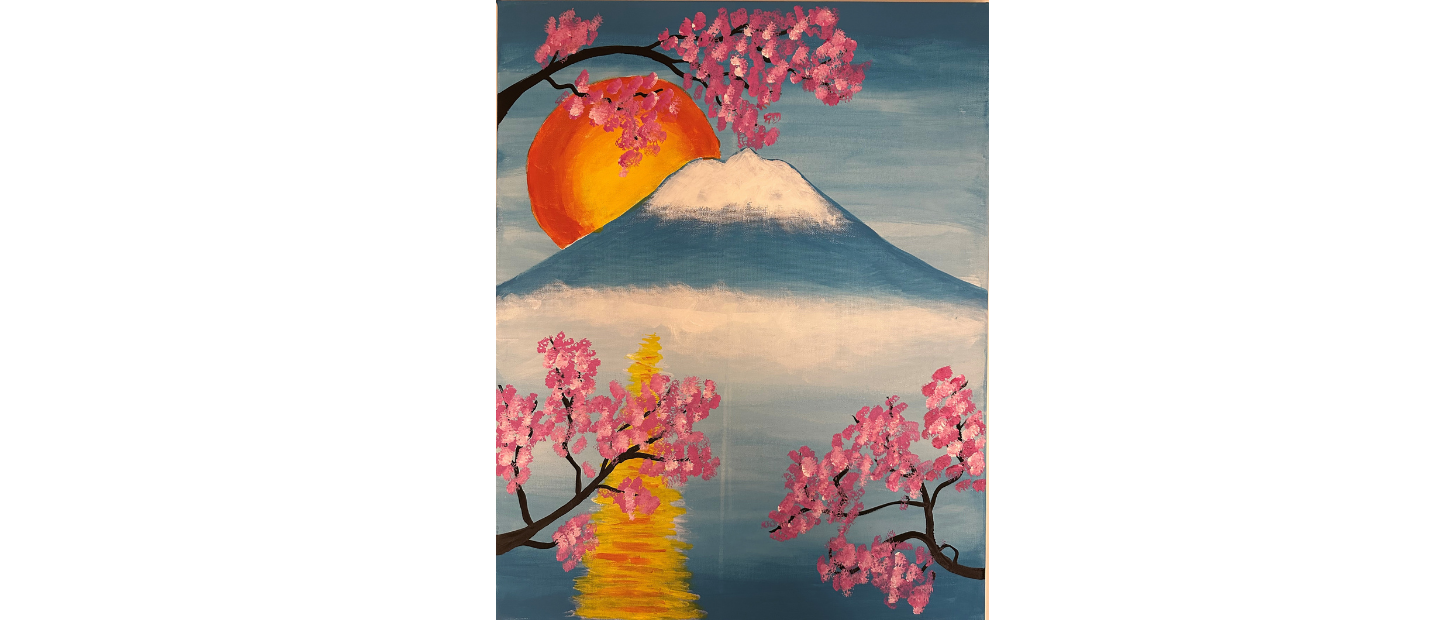
Recently I attended a ‘Paint and Sip’ class. Two and a half hours on a weeknight plus travel and parking. Someone else to set up the paints, brushes and canvas, clean up afterwards and a studio space I don’t have at home. Our subject was Mount Fuji with blossoms and the rising sun. I enjoyed painting for the first time since school, over 40 years ago. I was lost in concentration and flow. For someone who is driven by self-improvement I would love to go back each week and get better, as all I could see with my end result was my amateur efforts and room for improvement. I wanted another opportunity to do better. The reality of my busy schedule is that it was a challenge to block the time off, leaving me catching up on the weekend with admin, and unlikely to ever repeat the experience until my retirement.
Fortunately, I am also lost in the flow state when I am creating images, video and music with AI. Time is consumed through creating the story, prompting iterations, curating outputs, and putting it all together, but with flexibility to suit my timetable. I can dabble for short periods without any set up or clean up time, in the early hours of the morning or late at night.
Is my AI filmmaking art?
- Intent: Are my films deliberately created to provoke thought, challenge ideas, or express emotion? Yes, they challenge the stigma of urinary incontinence, raise awareness about the risk of falls in the elderly, prostate cancer screening and unconscious bias in the workplace.
- Context: The setting and historical moment. Marcel Duchamp’s Fountain, a ready-made urinal placed in the context of an art gallery, forced viewers to question what art was. AI films are a new medium in a new era.
- Skill and Creativity: In the modern era of abstract or conceptual art, concept may override traditional skills. A single prompt to create an image or video output may not be art due to a lack of human creativity or skill, but hours of iterations created and curated into a story to end the stigma of urinary incontinence, that tells stories of human suffering in silence, born from decades of work as an incontinence surgeon, could not be created by AI alone.
- Reception and Value: From the person who tells me they cried watching An Incontinent Truth because of the years of hiding their condition, to the film festival wins, this validates meaning and connection with an audience.
- The Lineage: Although photography, digital art and music synthesisers were all dismissed initially as the machine doing the work, each one eventually won recognition as art.
Barriers to engagement
With my demanding surgical career, I never had the time to attend art classes, or devote large blocks of time, especially in daylight hours to any artistic pursuits. This is why my earlier creative outlet was mainly writing, rather than the visual arts. At least with my children’s picture books I could create visuals, through an illustrator. I didn’t invest childhood hours in creative skills. Instead I was studying STEM subjects to gain medical school entry. Now at this stage of life, I don’t have the time to start the long road of looking at my poor early attempts, until I get to the standard of creating something I enjoy looking at, taking years to perfect traditional skills. I can create images and videos I enjoy, with no set up or clean up time, requiring no extra space at home, just using my existing computer. The software fees depend on tools and usage. They have monthly subscriptions that I only subscribe to when working on a film.
Democratising Creativity
AI can give anyone access to creativity. No art classes. Cost, geography, social and cultural barriers are reduced. A young girl with no access to art tools or classes in a remote or disadvantaged community can access online tools, some for free. This does not replace traditional art skills but creates access to those previously missing out on the benefits of creative engagement and expression. Traditional effort and methods may be better, but they have restrictions. This is not a comparison to traditional art, it is a comparison to an alternative of no art.
As someone who knew nothing about filmmaking or editing, AI helped collapse years of training. I had no equipment, no time for classes, no budget, no film industry connections. And I never thought of myself as artistic. I produced a film that I was proud of, before I was disillusioned by bad early results, and gave up.
AI presents a new pathway for the people who never had access to the old pathway. The single mother who never had time for piano lessons. The older woman with arthritis who cannot draw. The patient in palliative care who cannot leave the bed. The teenager in a remote town with no theatre, no choir, no studio. Generative AI gives all these people access to the benefit of the artistic flow state.
AI will allow the ideas, emotions and messages of previously unheard voices of new artists to reach new audiences.
Will we become creators instead of consumers, where future generations spend less time scrolling and consuming, and more time creating?
What about copyright?
This is an area that remains unclear and is unfolding. It is not settled and requires dialogue in a new era where AI art will exist. Consent matters and the law is still catching up. Ethics and governance must catch up and address bias in training data, copyright, ethics, and equity of access to AI tools for the disadvantaged. I believe AI access will become a basic human right.
People are shaped by a lifetime of work they never bought, so being influenced is not theft. All the art consumed and a lifetime of experiences influence an artist’s output.
AI tools are trained on work available online or open access, influencing their altered outputs. This is where we require a legal framework. The discussion of accessing training data through illegal means is another matter.
Copyright requires human input and the greater the human input to achieve the result, the stronger the case for copyright. The courts recognised the human-in-the-loop over a hundred years ago when in 1884 the US Supreme Court ruled a photograph could be copyrighted, not because the camera made it, but because of the human choices behind it, the posing, the framing, the light.
Art and health: what art equity could mean for humanity
Creative engagement is good for mental and physical health. AI can enable this at scale, across populations. The flow state is the mechanism. Skill level is not the variable. Engagement is.
AI art for personal creative engagement could be a population health intervention, not a competitor for working artists.
The health benefits of traditional art are well researched and map across mental health, surgical recovery, cardiac rehabilitation, dementia, postnatal depression, cognitive decline, and healthy ageing.
The flow state appears to be the mechanism by which arts engagement produces health benefits. With AI filmmaking I spend more time in the flow state and no time travelling to and from sets, packing and unpacking equipment or waiting around for everything that goes on behind the scenes.
The barriers of cost, transport, equipment, learning curve, cultural permission and the belief that one is not artistic fall disproportionately on those who could benefit the most from arts engagement. Currently the populations who would gain most are the populations least likely to engage.
The WHO urges policymakers to recognise the added health value of the arts by ensuring culturally diverse art forms are accessible across a person's lifespan, with a specific focus on disadvantaged minorities and marginalised groups. 2019 WHO Report
The economic impact of art engagement
The economic argument is documented. A 2024 report for the UK Department for Culture, Media and Sport valued the health and wellbeing benefit of cultural engagement for adults aged 30 to 49 at around £8 billion a year, using the Treasury's standard health valuation. Reduced healthcare costs. Increased productivity. Better caregiving.
Research into the benefits of generating art with AI is essential to realise potential population health and economic gains.
What about displacement?
My films are non-commercial, freely available, social impact assets. I am not displacing anyone. If people are creating art for their own wellbeing, the benefit is the act, not appreciation by others. If more people become artistic through the democratisation of art by AI, there will be a greater artistic pool for non-AI-assisted artists to emerge, and from which that maestro can evolve.
We need more artists in the world, now more than ever
The arts are the one thing that is meant to bring people together and build empathy across cultures and diversity. Art is a way for people to communicate their views and help others understand their world.
What about community?
Currently many artists share their work online to expand the reach beyond physical galleries and spaces and to reduce the costs associated with these. Many artists work quietly in isolation in studios or retreats for their best work. Some are even reclusive. Artists creating work on a computer can engage with online communities or come together in AI exhibitions and film festivals and screenings. People’s desire to engage in community will adapt.
Skills from AI art
Different skills may be enhanced by AI art: critical thinking, prompting, iterations and curation (taste and judgement). How will honing these skills assist traditional artists and those not working as artists? Will new skills make a traditional artist better, or will benefits carry over into other work?
Art education
If you don't get young people engaged from an early age, it's very hard to convince people later to engage in art. Many of the jobs the next generation will hold do not yet exist. The skills that matter are critical thinking, creativity, compassion. Arts engagement supports all of these.
In schools we want kids to learn by real-world experience, experimentation, and getting messy. We don’t want to reduce traditional art in schools, but generative AI tools, properly introduced, give every school access to arts engagement, especially when the alternative is no art at all. Not all schools have the same funding, access to art teachers, access to art equipment, tools and space.
Governance, Safety and Ethics
Guardrails are needed to ensure outputs are not biased or harmful. Training data should represent cultural diversity and non-English speakers. Accountability falls on the tech industry, governments, organisations and users.
The era of AI art is here. AIFilm4Good will not be remembered for what we feared about the generative AI revolution. It will be remembered for what we made of it.