The Too-Busy Pile
A free bladder diary app, built by a receptionist and a surgeon. Neither of us can code.
Dr Samantha Pillay OAM
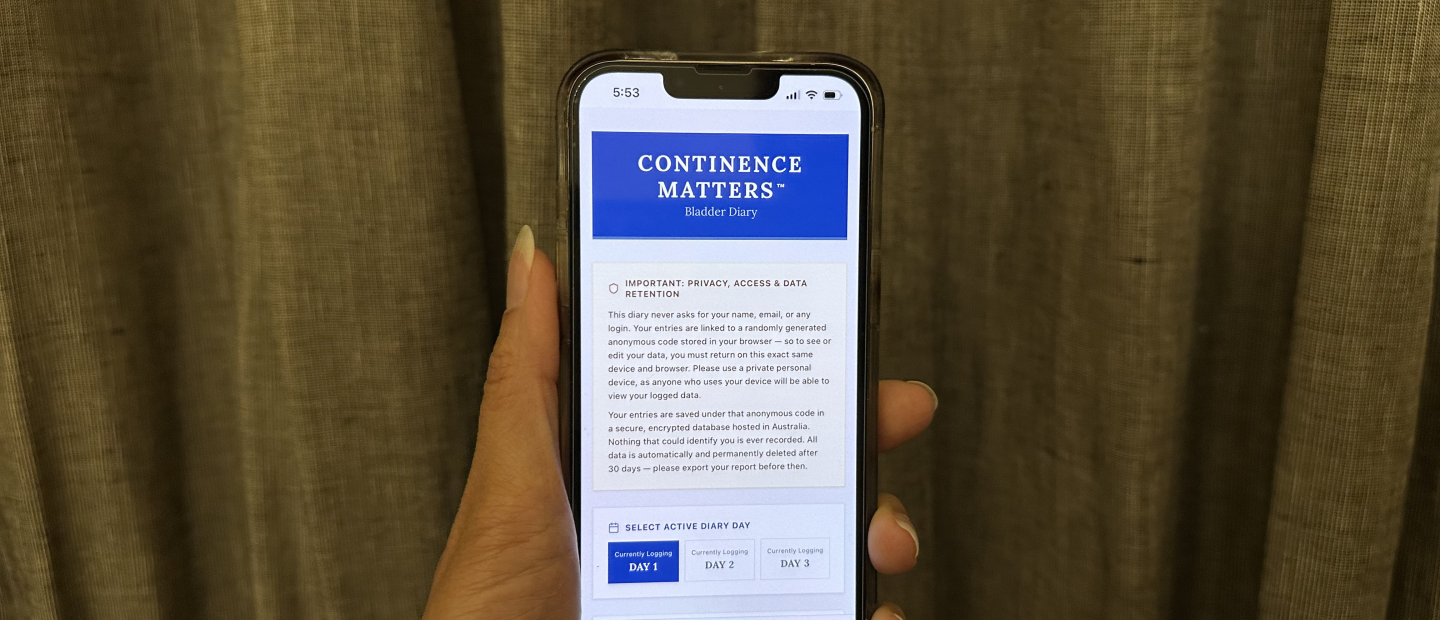
Every doctor I know keeps a too-busy pile. Not a physical pile, although mine has one of those as well. It is the list of projects that matter enough to keep but never enough to schedule: the ideas that live at the bottom of the inbox and come out at midnight, because midnight is when a surgeon's own projects get their turn. If a thing cannot be done between the end of an operating list and sleep, it does not get done.
For about ten years, my too-busy pile held a bladder diary app.
A bladder diary is one of the most useful tools in continence care, and the least glamorous. Three days of recording every trip to the toilet: the time, the volume, the urgency. For decades the technology has been a sheet of paper on a clipboard and a measuring jug kept by the toilet. Patients lose the sheet, forget to fill it in, or quietly give up. I never blamed them. We were asking people to keep handwritten records of the condition they most wanted to pretend they did not have.
There were apps, but the good ones charged money and the free ones ran advertising beside a patient's voiding record. What I wanted was simple to describe and expensive to build: free, ad-free, private. Some years ago I spoke to an app developer, and the conversation was short. The economics of custom software assume the software will one day earn its keep. Mine was never going to earn a cent, because I fund my community projects myself and I wanted this one given away. A surgeon who cannot take meetings in office hours, commissioning software that would never make a dollar, is not a promising client. Back on the pile it went.
Then AI arrived, and I ran a test. The test was not whether I could build the app. The test was whether my medical receptionist could.
She has no coding background and no technical training. What she has is more useful: she knows our paper diary inside out, because she is the one who hands it to patients. Using Google AI Studio, she described what we needed and built the first working version herself. The project came off the pile not because I finally found the time, but because the barrier dropped low enough that time was no longer the question. That is what has actually changed. Not what is possible. What is startable.
With her version standing, I came in and did the parts that needed a specialist. The app now does things our paper diary never could. A patient can record output only, or fluids in and out, whichever their clinician requests. It handles catheter volumes for patients who self-catheterise. It records bedtimes, wake times and pad changes, adds everything up, draws the charts, and produces a tidy report to bring to an appointment. It even calculates the nocturnal polyuria index on its own, which means no more reaching for a calculator in the middle of a consultation while a patient politely watches me do arithmetic.
Then I did what surgeons do: tested everything, trusted nothing, and fixed what was wrong before anyone else was allowed near it. This part is not optional. When I asked the AI about its own work, it sometimes described the app it had intended to build rather than the one it had built: features that were not there yet, safeguards that were not yet real. It is a brilliant builder and a confident storyteller, and those are two different skills. So before any patient touched it, I checked every claim against what the app actually did, the way we count the instruments before closing.
The cost of all this was my time, my staff's time, and a set of skills neither of us had a year ago. In dollars, almost nothing. The hosting costs me about as much as a coffee, and I am glad to pay it. That arithmetic is my favourite feature of the whole project, because it removes every reason to keep the diary to ourselves. It is now free for any GP, continence nurse, continence physiotherapist, aged care provider or clinic, anywhere, to use or to embed on their own website, and patients can send their completed diary to whoever cares for them. It lives at bladderdiary.continencematters.com. It never records a name, and everything deletes itself after 30 days.
One in three Australians live with incontinence, and most have never told their GP. I will spend the rest of my career helping them one at a time, because that is the nature of surgery, and I love the work. But an operation needs me in the room. This does not. Somewhere tonight, a patient I will never meet can keep a diary I will never see and hand it to a doctor I will never know.
My work, continuing without me.